Category Archives: Uncategorized

reborn

There is a moment after a baby is born into which I tiptoe, still feeling surprised I’m allowed. I place the soft and sinewy creature we call a newborn under warmth and examine her from head to toe, looking for anything of concern, and then I give her a bath. Most babies close their eyes and stop crying when their hair is being washed, their first spa experience, I always say. This is when the hard work is done, the room is mostly empty, and things feel still and sacred. There’s a tired, triumphant mama in the bed, and her companion in a chair or over my shoulder taking pictures, watching. When all is done, and baby is plenty warm, I wrap him up and give him to his mother. Then, I tiptoe back out of that moment, because it doesn’t belong to me.

These moments tend to give me pause, and I remember my own birth experiences, sometimes with a tenderness that hurts. I’m probably done with all that–my baby is two, and things are moving forward. I’m struggling to parent the ones I have; learning these new stages. You don’t know, when you have your first baby, that you’ll look back on those times as simple. They certainly don’t feel simple. And now, it doesn’t feel simple either. Perhaps we feel ill-equipped all along the way.

My work, in a way, keeps that tenderness alive for me, which is a blessing and a curse. I crave that feeling, just one more time, of they swaddled treasure on my chest, the way time stops for a little bit but not nearly long enough. I think, I didn’t do it quite right, not yet, maybe I would next time–but we all know that’s not true. Each child shows us our trying-but-broken self in such undeniable starkness, and there will never be a thing that we get completely right.

I think of this, when I wrap up the baby. It reminds me to be gentle with myself, too–to mother that part of me that needs so much understanding. In therapy, I’m learning to see my children as healers and not just instigators of all that searing, intolerable emotion. They are here to teach me at least as much as I’m here to teach them. I’m taking steps toward wholeness, for myself and for them, so that they know what it looks like to seek happiness, so that they know they have permission for that too.

The afterglow: who’s to say we can’t find that in our everyday lives? Children are born, and parents are reborn through that, and continue to have to stretch out of our current dwelling places. It’s the only way to move forward.

1 Comment

Filed under Uncategorized

Raising Up Sisterhood

Friends, I have a beautiful guest post to share today. I had the opportunity to work alongside Stacy Hart in a Perinatal Services Unit and got to know her there. She’s a skilled and compassionate nurse, an invested conversationalist, and she has a peaceful conviction about her that really shows up in her words today. I smiled when I read them, because I’ve never felt anything but support and genuine interest from Stacy. She models the strengths of women well–strengths that sometimes are hidden by the heavy things that burden us. Her post today encourages us to lay down those heavy things and come out from our hiding places. I hope you enjoy it and are encouraged, as I certainly was!

Little girls with string tied between their beds. Hiding giggles in pillows as they pass notes, dolls, and sisterhood back and forth on their homemade contraption. Footsteps coming. Flop down fast, try to trick Daddy; make him believe dreams are the only thing awake in this room. He peeks in the door, sees eyes squeezed too tight, smiles playing at the corner of mouths, and hears the faintest attempt at fake snoring. He grins, closes the door, knowing this is more important than sleep.

It always will be.

This aching. This longing. This need–for each other.

Community. Connection. Sisterhood. Family.

Life is born and the first cries from a sweet new babe’s mouth beg for comfort, to be held close, to be wanted. Needed.

We are women. We were created for community. Designed to do life side by side.

But the world says no. Society screams stop. Experience teaches us to hold others at an arm’s length. View them as a threat. Assume the worst. Give no benefit of the doubt.

Then we turn on ourselves, and become more harsh than any critic would dream of being.

I must have it all together. Be the most successful. Be better than everyone–then I will know success. I must dress flawlessly. Emulate airbrushed lies in magazines. I must devour the right parenting books and produce children who never bite me or throw tantrums in store aisles. I must keep up appearances. Put my best foot forward. No matter what the cost. This is where happiness is found.

Eventually our world screeches to a stop. Life happens around us. And we believe all of its lies.

We know we will never be what SHE is. We will never be that good. That talented. That beautiful. That successful. That carefree. That skinny. That crafty. That funny. That desirable. That intelligent. That perfect.

Comparison is the poison that devastates community.

Does it really matter if you breast feed or use formula? Co-sleep or have separate rooms? Does making my own baby food make me a better person? Does slinging verbal abuse in the comments section of parenting articles mean I win? Does gossiping about the popular girls make you prettier? Does a brand name give me more worth? Does hurting someone else ever make me better? Happier?

No. No. Every time, no.

Defeat threatens. But hope prevails.

I have heard a whisper. Felt a stirring.
And I know that I am not the only one.

The rumbling is off in the distance but it is steadily growing louder, more powerful. I hear the voices, the hearts, the souls, of thousands of women who have decided to say…

Enough is enough.

Comparison will not steal my joy.
Comparison will not poison my sisterhood.
Comparison will not win.

Community.

Community is making a comeback.
Possibly one of the greatest and most important comebacks in all of history. Think I’m exaggerating? Think again.

When community thrives, when selflessness and a servant’s heart reign, selfishness dies.
When community is the goal, competition, comparison, and mommy wars lose their sting.
When community exists, lives change.

Where community lives, Love reigns.

Imagine this world.

Open your eyes.

The rumbling is all around us. Community coming back to life. In neighborhoods, in churches, in offices, in blogging communities, on social media: women are realizing we need each other.

Friendship rediscovered. True connection. Life to the full.

When you stop looking at someone, and their talents, and all of their beauty, and their allegedly Pinterest perfect life, as a threat, your eyes are opened to who they really are.

A woman. A wife. A mom. A heart and soul as weary, as exhausted and as lovely as you are.

This movement. This powerful force of women who challenge, encourage, and inspire me every single day. This wave that will change society forevermore. It starts small, nearly too small to notice at first.

It starts with weary moms at Target smiling at each other so we know we’re not alone.

It starts in book clubs, and spinning classes and yoga studios.

It starts when we stop looking at each other through the eyes of comparison.

It starts when a tragedy happens and thousands of women on Instagram reach out to a family experiencing unbelievable loss.

It starts when we ask real questions and have real conversations and discover how desperately our soul was longing for friendship kindred.

It starts when we call out the beauty and the talents and the extraordinary we see in women around us.

It starts when we believe that we are our very best when we do life together.

It starts when a new mom has meals delivered to her door and her toilets scrubbed.

It starts when we introduce ourselves at playgrounds instead of staring at our phones.

It starts when there is no fear of judgement…
In asking for help.
In revealing our weaknesses.
In being vulnerable.
In speaking of the uglier parts of life.
In asking forgiveness when we are wrong.
In dying to the disease of pride.
In asking women we love to journey with us.
In admitting we need each other.

It starts with you. It starts with me.
And it is so time.

We’ve got this.

10341620_10203800721448775_1065287241206648272_n

Stacy is a wife, mother to three beautiful daughters, Labor and Delivery nurse, and in case you couldn’t tell, she’s passionate about the power of community and friendship among women.

1 Comment

Filed under Uncategorized

thin

In the morning, I lift her out of the crib. She rests her head on my shoulder, tucking her little body into the side of me. We whisper our morning greetings to each other. It’s Easter Sunday, and I stayed up last night to press her little denim dress with the ruffled skirt–one, two, three layers. I slip it over her head, and button the little white lace sweater over it. I carry her to the bathroom and comb her hair, telling her all the while how beautiful she is. (And she is! My goodness.) We’re almost done, and she slips a little toward the round sink. I catch her, but she’s felt the scare and starts to cry. It takes time for her little self to calm after things like this–five minutes of shhhhhh and pat and sway. My sensitive-souled girl.

Before, something like this would have stolen the morning from us.

Later, we eat breakfast at the church and wait while the big kids hide eggs outside. When they’re done, we march our three out the door. The boys are off in a flash with their buckets, having done this before. Aimee walks with her basket like she’s been practicing, stoops down to collect the eggs she spots. After four, she dumps them all out triumphantly and collects them again. We laugh, and take pictures, and shiver a little in the cold Spring wind. What is it about Easter, always chilling us in the thin outfits we insist on wearing?

I’m not trying to make anything more spiritual than it already is, and that feels good. This egg hunt, this celebration of Spring, is also a celebration of resurrection and all the rest of it. Whatever I may feel or not feel, it doesn’t matter right now. I am rediscovering simple, good things. Among them: I have a daughter who laughs and runs (runs!) with her Easter basket, I have two brown-eyed boys–one who still belly-laughs and one who goes deep into his thoughts and says, when the pastor asks, that Easter is about celebrating hope. I have a man by my side with warm hands and an imagination about life. We’ve dreamed together, and we’ve learned to let ourselves be tired.

I could never make these things more beautiful than they already are.

I’ve been holding two things side by side: great beauty and great sadness. I make inquiries about therapy, for myself this time, because I want to be happy. That is all, and it is enough: I want to be happy. I am worthy of happiness, I tried recently to say to myself in the mirror, and couldn’t quite look my reflected self in the eye.

I’m not sure why I’ve waited so long to ask for this kind of help.

I talk through the hour-and-a-half session like it’s ten minutes, and learn to breathe into the spot in my chest where the pain throbs. It helps. Let me be your container for awhile, she says, and I agree. I feel like there is an ocean to organize into glass vials–to label and sort and store. I can’t fathom it, really, but it’s comforting to think that someone else can. You don’t just walk away from a fear-saturated belief system and have no cost to pay. But it’s time.

Time for new things to be born.

2 Comments

Filed under Uncategorized

Glitter, Green Converse and How to Get Red Wine out of White Linen: Things I’ve Learned Since Becoming Episcopalian

It’s been awhile since I’ve shared a guest post; a whole lot of life has happened. But, today I get to host my friend Deborah Stambaugh, and that is a very exciting thing. I met Deborah officially when we were college freshmen–but I probably should have met her many years before that. We went to the same church camp every summer in Mountainair, NM (some of you know exactly what I’m talking about) and I remember seeing her and her three sisters and thinking how beautiful and cool they were (I was right–they are).  Deborah might be part of the reason I married who I did–I do know she saw the potential for our relationship long before I did. So thanks for that tremendous gift, Deb. And thanks for helping me laugh at myself, for modeling bravery, for glasses of “water” to drink around bonfires and glasses of iced coffee to drink in boring classes. I’ve always learned from your generosity.  

Hope you all enjoy her words today, and can find a way to breathe deep and trust the process you’re in. I’ll be doing the same. Happy almost Easter!

When James led us to the Episcopal tradition, many friends and relatives asked why.  His answer always started with the church calendar.  That was boring (and certainly the last topic that could ever be blog-worthy) so I often interjected my own response.  After many cycles of the calendar, I am beginning to understand.

It all started in Advent.  Looking for coffee in the great hall at St. John’s Cathedral, I found the smell of cut pine, families bustling to assemble their advent wreaths, glitter and cut ribbon all over the floor, and bystanders drinking coffee and enjoying the hubbub.

“You should make one,” James (my husband) offered.  He drank coffee and chatted instead of helping me.  So, I vindictively put glitter ribbon all over it.  He hates glitter.   He said it was beautiful.  I thought, “There must be something to this Advent thing if it can make him like glitter.”  Inspired by the wreath, James invited our neighbors to our house.  He said a short, but lovely, prayer and cooked a beautiful meal, which we enjoyed by the light of the first candle–a tradition we continue.

I paid no attention to the calendar until Lent approached and people asked what would be my Lenten discipline.  I retorted that I would stop “walking Central” and smoking cigarettes, but only for Lent, and that I would not give up the pole dancing gig!  Secretly, or not so secretly, I was repulsed by the idea of Lent.  Sometime during that first Lent I do remember thinking that Rev. Goodman was finally preaching proper sermons—about abstaining from sin and committing your life to God because Jesus sacrificed so much for you.

On my first Pentecost it seemed every woman at church wore a red hat, except me.

There are colors to coincide with each season of the church calendar.  Ordinary time is green.  James likes to wear Converse All-stars to match the color of the season.  Ordinary time is the longest season, so his feet smell awful by the end of it.

The glitter wreath, my abstinence from abstaining, my black dress in a sea of red, and James’ stinky feet were all I truly understood during that first cycle of the church calendar.

When Lent came around a second time, Rev. Goodman’s sermons sounded familiar (like real church) again.  This time, equipped with the experience of feeling (though in a rudimentary way) other seasons, I understood why the sermons were familiar—because it was Lent.  Then I realized, “I hate Lent because I’ve done 20 years of it.”  An evangelical emphasis on holiness combined with my own religious ambition resulted in a continuous effort to memorize scripture, pray, abstain, and otherwise improve myself so that I could be the best Christian possible and obtain a lofty status in the Kingdom of God.  It exhausted me.  Instead of becoming more Christ-like, abstinence made me judgmental and proud.

I gave myself several years of ordinary time.  Thankfully the Cathedral completely and utterly welcomed me in spite of my lack of enthusiasm.  Slowly a thirst for renewed spirituality burgeoned within me.

//

James was assigned to help at a small parish that did not have volunteers to prepare and clean up communion.  After service he wetted the wine-stained church linens, put them in a plastic bag, brought them home, and left them on the counter to rot.  Three days passed.  Then four.  My options were to throw out the whole mess or attempt to salvage it.  I dug out my Oxyclean and an old tooth brush.  While working on the linens, it dawned on me that I was participating in an ancient tradition.  Though separated by 2,000 years of time, I was working together (in a symbolic or possibly more than symbolic way) with the people who performed the most honorable task of preparing the corpse of Christ for burial.  I thought about them.  I participated in their grief.  I wondered what thoughts they had as they tended the vacant and mutilated body, whether they were mad at him, knowing he didn’t even put up a fight.  Were they mad at the authorities who caused his death?  Did they dare hope for a resurrection?   How horrible it must have been to grieve without the hope I have in the resurrection.  Luckily it was only three days.  I wished I could share my Oxyclean and washing machine with them.

Somehow cleaning linens made Christ and his people more real to me.  I understood the value of early church traditions, and decided to participate.  Each year as we circle around the calendar, I gain a deeper understanding and appreciation of the celebrations.  Each year my participation is seasoned by my own life experiences.

This year we celebrated Advent right after I experienced the longing and anticipation of waiting for the birth of my own child.  I thought about all of the people who shared with me in the joy of anticipating my daughter’s birth.  I considered the Virgin Mary’s anticipation as she felt the Child quicken in her womb, as she waited to meet him, to introduce him to the world.  I felt anticipation of Christ’s return and longing for His presence in my daily life.  Advent is “the fast that feels like you’re just too excited to eat.”

Jane, the Cathedral’s former Christian Education director, hung a bell on my son Edmund’s wrist the year he had the role of Jesus in the Christmas play.  Nora, my daughter, had that honor last Christmas, and I stole a bell from the Cathedral to put on her wrist.  I will hang those bells on my Christmas tree every year until I die, and remember with joy the births of my children and THE BIRTH we used the bells to celebrate.

When we started planning our move to Virginia, I desperately needed reassurance that God would guide.  Epiphany provided great comfort.  Epiphany is “a star from God to guide the Magi.”

Last Sunday we waved palm branches and processed around the neighborhood.  I told Edmund about Jesus coming to Jerusalem 2,000 years ago, and about how everyone was so excited they put palm branches on the ground for his colt to walk upon.  I refrained from sharing the rest of the story.  He will hear it in due season in accordance with the calendar.

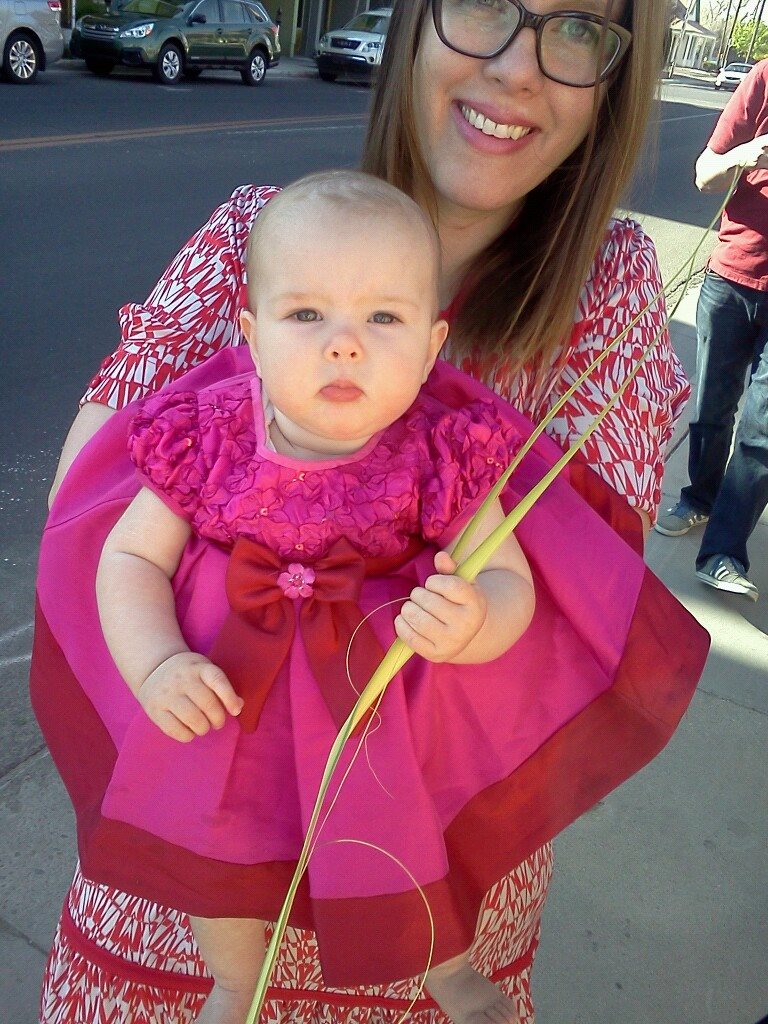
My mom celebrated Easter (in the Protestant tradition Easter is death, burial, and resurrection all on the same Sunday instead of breaking it apart over Lent and Holy Week) by hand-sewing dresses for each of her four daughters every year.  As a child, I knew Easter was important because of the way mom prepared for it, and because I felt beautiful on that day.  I wonder if Mom’s tradition came from my great-grandmother and her Anglican/Episcopal ancestors.  I share the colors with the children in my life because I think dressing in accordance with the season is a way of preparing to understand what is happening at church.  I have dismal sewing skills, but I enjoy buying purple dresses for my niece, Ella, during Advent, and talking about why we wear purple. (I am sure someone in the family will correct all of the misinformation I’m probably giving her.)

I will probably wear jeans on Pentecost as a way to welcome others who don’t know about the red hat thing.  But you can rest assured I will have a beautiful green hat for ordinary time…and maybe some Oxyclean for those nasty green shoes.

DebandNoraPalmSunday2014

Deb is a wife of nine years, a mother of two small children, and an attorney in Albuquerque, New Mexico who drinks way too much coffee.  She enjoys estate sale shopping with her husband and long walks.

2 Comments

Filed under Uncategorized

all the good

There are things that drift away
Like our endless numbered days
Autumn blew the quilt right off the perfect bed she made
And she’s chosen to believe
In the hymns her mother sings
Sunday pulls its children from their piles of fallen leaves

-Iron & Wine, Passing Afternoon

I was allowed wild. I spent days in the sunshine, gathering dirt into a big metal bucket, spraying water from the hose, mixing it into a consistency just right for my purposes. A rusty-but-solid metal table served as a perfect oven for the discs of earth I formed. I sat in the grass while they baked in the sun, caught garter snakes, picked at scabs, had big romantic thoughts about being a pioneer. Over and over.

Repetition and big open spaces of time. Sun-soaked skin. Dirt-perfumed hair. My soul was well-tended.

Messing around with dirt is a hopeful act–investing in beauty and nourishment together, trusting in the eventual delight of the senses. It implies not living day-to-day. It implies rootedness. It implies faith and looking forward to the future. When my precious cakes were ready, I’d gleefully break them apart, scrub off the metal table, stack my kitchen supplies and look forward to doing it all again the next day.

I learned something nameless in those hours, but left it outside the doors of church because it wouldn’t fit through. Two messages came to me in those days; two ideas planted way down deep.

One: this life matters in and of itself.
Two: this life only matters in the context of the next.

I hope what is true will root down and remain, and what is false will simply float away, like I used to think I would do someday.

//

Standing to have the ash smeared on my forehead felt like a reunion with what I used to know: it’s no waste of time to live here. I’m growing less afraid to salute the sun after knowing a dense cloud of gray days. My children instinctively flow out the door like a thawed creek, digging for worms and gathering sticks, oblivious to time. I spend time pulling off winter-soaked foliage to reveal richly dark soil underneath. My fingers bleed and my nails are black; they look honest to me.

I was given, in part, a religion of earth. I was given time. Baptized in a deep river, sun-grown during all those solitary days, with a seed planted that fearful, contained systems have kept dormant far too long. I choose to risk it now.

I’ll take the possibility of being wrong in exchange for not needing to make the up-springing of green things my enemy.

I will love it here. I will make a home here, dig down and let the cool soil soothe my burning hands, after so many years of snatching them out of hellfire. 

Oh, to see again what the little girl knew. All the good is God.

4 Comments

April 3, 2014 · 11:12 am

dearest ones,

May you know what it is to rise each morning with work to be done.

May you know the stillness of an afternoon with a space laid bare for thoughts to gather and be stirred into vision.

May you look for the dim light in the distance when you’re caught in a fog–may you chase it with stubbornness and wild hope.

May you sniff the air and know that snow is coming, hike alone to meet with God, and put all your senses into noticing a crackling fire before you.

May you know silence–may you enter into it gladly, eager for its lessons.

May you travel and fill your minds with strange and delightful newness, may you see things that bother you, ask questions, listen well and long.

May you be overcome with curiosity from an early age and feel freedom to find out where the rabbit-hole leads. And, may you know that in this life you have a True North, watching and cheering, waiting to hear all about it.

Live, babies. Live your questions and answers. I can only see God smiling over you.


Inspired by Terry Tempest Williams’ When Women Were Birds: Fifty-Four Variations on Voice.

2 Comments

Filed under Uncategorized

A Force Stronger than Fear: A Book Review

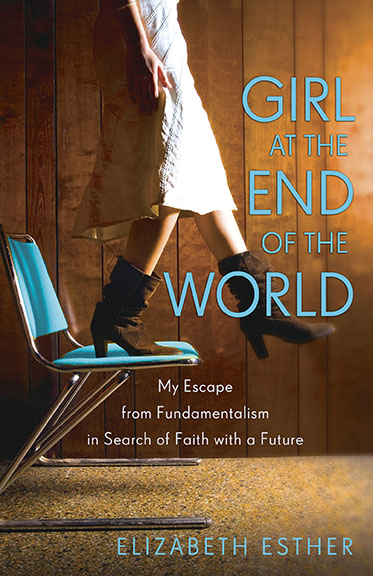
I downloaded my copy of blogger Elizabeth Esther’s memoir Girl at the End of the World: My Escape from Fundamentalism in Search of Faith with a Future on Tuesday morning. By Wednesday morning, I had finished the whole thing. This is not common (or even possible, usually) but her words were so riveting that I snuck moments in whenever I could. Throw in a load of laundry, read some, put the baby down for her nap, read some more, build train tracks with my toddler, read again.

The Girl at the End of the World

In her first book (and I hope there will be more) Elizabeth Esther tells the story of her childhood in a spiritually abusive fundamentalist cult called The Assembly, founded by her grandfather, and her slow escape from the cult as a young mother and wife. It’s not easy material to take in–I cried more than once and even stopped to beg-pray at one point. God, help me not to take advantage of the power I have over my children’s view of You. Please.

Power and fear are major themes in the book. At a young age, we see Elizabeth enduring “discipline” from her elders, and nothing but contrite submission and total surrender is accepted in return. She suffers from severe anxiety and panic attacks related to her fear of being left behind if the rapture should happen and she hasn’t properly confessed all sin. Her family doesn’t accept mental illness as a reality though, so she never receives treatment. She believes, because she has been taught, that The Assembly is the way to God–and essentially this means that her grandfather and his followers are the way to God. The only empowerment is unquestioning obedience, because it will get her to heaven–even if it means her earthly life is miserable.

The motif of mothers and daughters is woven skillfully throughout the book. Tender and impulsive, Elizabeth learns to keep a safe emotional distance from her grandmother and her mother, as they are responsible for what seems like the majority of correcting her “character flaws”. She endures daily spankings–reminders that she’ll never be good enough.

Adulthood offers no freedom. Elizabeth marries a kind young man named Matt. The relationship offers some solace because the two are friends, and because Matt isn’t domineering, but Elizabeth soon realizes even their relationship isn’t safe from the scrutiny of The Assembly. Ultimately, they don’t have the power to make decisions about what their life together will look like.

I pray until Grandma is satisfied. She thinks I am weeping for my sins, but I am weeping because I finally realize that I will never be free.I see life stretched in front of me, and I weep for all the dreams I’ll never fulfill and for the children I will bring into this oppression. I weep for naively hoping my marriage could be different from all the other marriages in The Assembly. (Kindle ed, p. 127)

It takes motherhood to give Elizabeth the courage to leave, even though it doesn’t happen right away. In a pivotal scene, she’s expected to spank her daughter on her first birthday, a punishment for reaching for a bowl of chocolate. Children are trained to obey to the point that they won’t reach for sweets or toys without their parents’ pre-approval. Her mother dutifully fetches a wooden spoon, her grandmother looks on approvingly. Elizabeth shuts herself and her baby girl in the bathroom, torn between her own maternal intuition and the powerful pull of the cult’s teachings on child discipline–a misnomer because the purpose is to coldly break a child of any notion of preference or individuality.

She stares up at me, smiling and innocently unaware of what is happening. It is her first birthday. She is my baby, and I am doing this to her. I am training her the way I have been trained. Indeed, to break her will, I’d begun spanking Jewel at six months old.

Oh God. Help me. Help me now. I wait, the tears still coursing down my cheeks.

And there it is. A small shift. The tiniest point of light breaking through my darkness. It is revelation. You don’t have to break your daughter the way you were broken. (p. 137-138)

In this moment, the trajectory begins to shift. It’s the slow gathering of courage through Elizabeth’s relationship with her oldest daughter that builds into a new kind of strength over the years. She and her husband confront her grandparents for multiple abuses of power and finally leave the cult. They spend years acclimating to the outside American culture and trying to find a new way to worship and connect with God. She’s drawn to the safety and beauty of Catholicism, even though she strongly disapproves of it at first.  She finds strength through Mama Mary, explaining that when she couldn’t find Jesus, she went looking for his mother. She gains the strength to parent according to her own conscience, to be gentle with herself and seek the treatment she needs, and eventually even the strength for reconciliation with her parents.

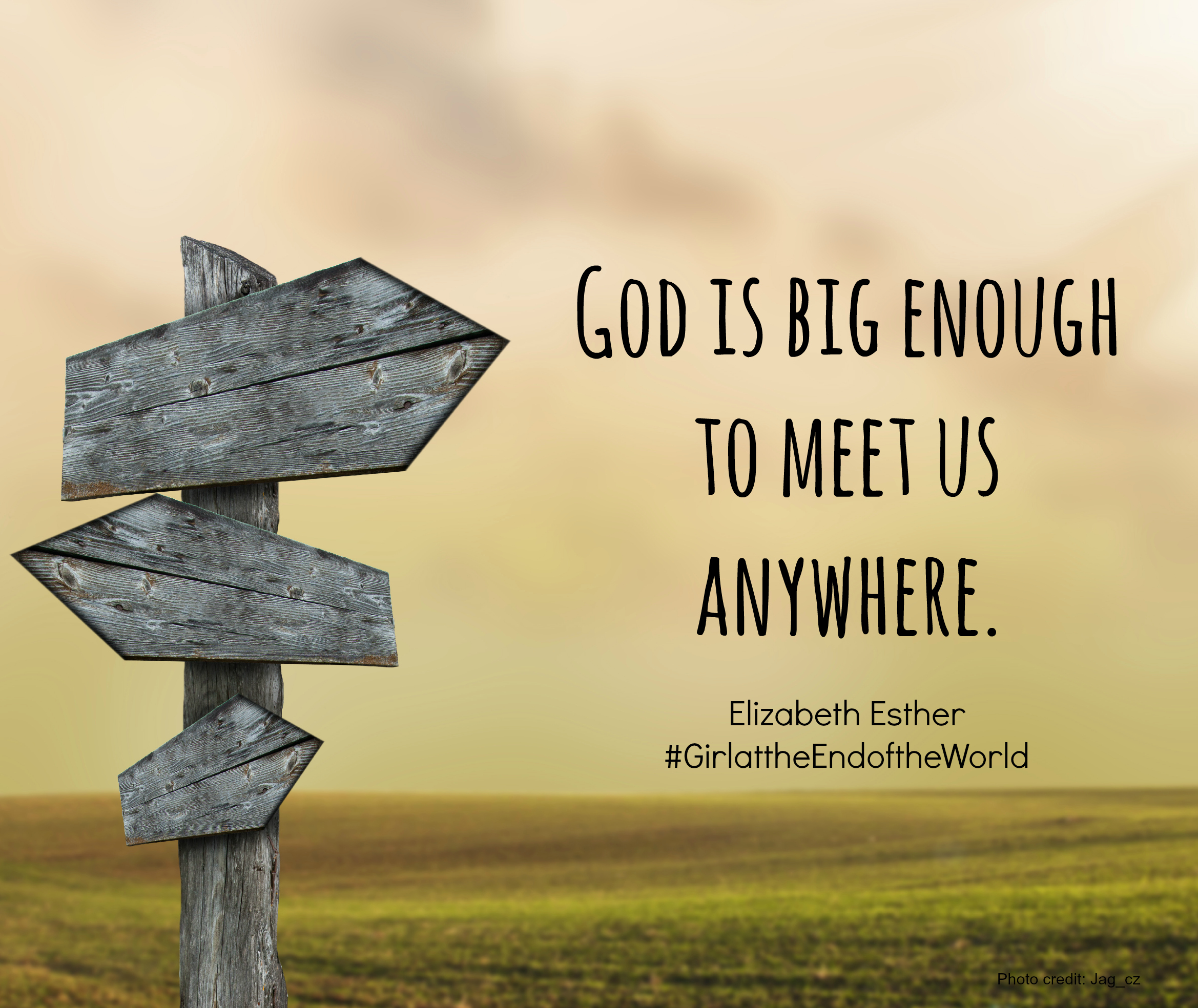
As I read Elizabeth’s story, the goodness of God became more and more evident. I was reminded that we’re drawn to the Divine in many different ways, and what matters is that we bravely seek as we are led to. As she puts it so well:

God is big enough

This book shook me up, I’ll be honest. I’ve felt emotionally raw ever since I finished it. I think this is a testament to Elizabeth Esther’s ability as a writer to transfer her real life experiences to the page. Her voice is warm, candid, devastating, and at times hilarious (love me some King James-flavored humor) and left me feeling grateful and hopeful for the power of love.

It’s stronger than fear. Praise be to God.

You can pick up a copy of this book herehere, OR leave a comment for a chance to win a free copy, on me! You can just say hello, or share a thought on this post, or maybe tell me about a time you were brave in your spiritual journey. I’ll pick a winner on Monday.

*UPDATED: The winner of the book is Erica B, who left a comment on my Facebook page. Congrats Erica! Look for more reviews and giveaways soon.*

4 Comments

Filed under Uncategorized

mystic

Earth’s crammed with heaven,
And every common bush afire with God;
But only he who sees, takes off his shoes–
The rest sit round it and pluck blackberries.

-Elizabeth Barrett Browning

Lately I see this gorgeous bit of verse everywhere.

I listened to a sermon about beauty yesterday; about how the Wise Men didn’t know they were looking for Jesus specifically, but they followed beauty and so they found him, eventually. The point was this: if you follow beauty all the way back to its original source, you will find Jesus, because anything and everything beautiful is from Him.

I love this. God seems more beautiful than ever when I think of Him this way.

I suppose it was the exact thing I needed to hear, because I just stopped what I was doing and built a pile of stones right there. I prayed, curled up on the couch while Silas tinkered, about beauty and seeing, really seeing, and melancholy and anger and making decisions that are fear-based, about my heart-dreams and my sins against my own heart. About love and regret and persistent pain.

I leaned against my dearest Friend, and wondered why at times I cannot trace all this beauty back to its Source. Why I am satisfied to tiptoe around these burning bushes. In the ordinary of our lives, there is such loveliness. There are whispers of what could be, of the true potential of all of us made in the image of the One who transcends it all. I need to remember this, in all of my interactions. I need to ask more people what they are dreaming of and where they see beauty.

Fear is strange because we fear our deepest desires sometimes. I fear becoming real, like the Skin Horse, because it means being worn down, but I’m worn down to exhaustion from retreat and withdrawal. Could there be anything more wonderful than being real? When you meet such a person, you remember. I sometimes think heaviness is my own personal thorn; I can’t comprehend all this energy and lightness around me except for the brief moments when it flickers over my head. I don’t seem to have many answers, but I recognize beauty, and I can give thanks for it.

Looking around is a good starting point.

I may never understand my own holding back. I may never deem myself worthy of such wild, limitless love. Oh, but may I continue to know it anyway. May I somehow point the way to the Source, gasping alongside the rest of creation at the glory all around us. May I be brave enough to believe it all matters.

I invite it. I want to be a mystic, taking my shoes off in ordinary places.

*originally posted December 5, 2012 on Noting Now.

Leave a comment

Filed under Uncategorized

differing graciously

Last night, Ricky and I had the opportunity to hear Brian McLaren speak with Amy Butler, pastor of Calvary Baptist in DC, as part of their Compelling Conversations series. Brian’s books have had a meaningful presence in our lives for quite a few years now, ever since our friend Heath lent us his copy of A New Kind of Christian. I didn’t know at the time just how much I would come to appreciate progressive Christian voices, or how much of a lifeline they would be for me.

20140311_185259

The conversation centered largely around the tension between evangelical American Christianity as it’s more commonly practiced and the folks who have grown increasingly uncomfortable with it…emergents, progressives, post-evangelicals, or whatever else you want to call them/us. I had to laugh when Brian mentioned that when people accuse him of heresy or falling down the slippery slope, he can only respond, “it’s much worse than you think.”

It’s been painful but liberating to realize I’ve spent most of my life entrenched in two types of Christianity that tend to fancy themselves the only type of Christianity: fundamentalism as a child and evangelicalism as a young adult. Those systems are not all bad or all good, of course, but there are good things outside of them. There are other ways to be faithful, to seek, to serve. I think that’s good news for all of us.

I’ve realized something big lately–I desperately want to be understood, especially by my friends who are still “in” systems from which I’ve stepped out. This desire grew so much over the years that I wanted to scream out my thoughts sometimes. Brian spoke some words last night that helped me to see how I might handle this better.

He offered this suggestion: when a friend, family member, etc. says something that you disagree with, maybe even find wildly offensive, say this: Wow, I see that differently. Then, leave it alone. If they ask you to explain, do so at another time, but not right away. In this way, you show that you’re willing to speak up but you don’t have to try to convince them of anything. It’s refreshing, and it opens up some space for dialogue. I think my favorite line was this: it’s really a gift when you can be different and not uptight about it. I have some work to do in that area.

In the same vein, he spoke of what an African theologian once told him: “Have the courage to differ graciously.” Brian noted that because this man approached theology from an African perspective, it might be called African theology, as when a woman approaches theology it might be called feminist theology, or when a gay person approaches theology it might be called queer theology, but a white European-based male approach is simply called theology (probably with a capital T). People approach theology differently, but some think their way is the way. We differ, meaning we are able to voice our disagreements, but we do it graciously, not defensively, not to prove a point, but as an effort to build something over time.

Not everyone can or will acknowledge their own bias and influencing factors. We should try to, and we should have grace for those who can’t see it yet. We should have grace for all the things we haven’t realized yet, too, as well as all the obtuse things we may have said in the past (yeah, that would be me).

I think I need to work on contentment with this: I am understood well by a few people. That is a gift, and it is enough.

Listen is my word for 2014. I’m learning that there’s nothing passive about listening–it’s a daily choice to acknowledge that whoever I come into contact with has a point of view that their life has given them, and to treat that gently. It doesn’t mean hiding my disagreement, but it does mean seeking to understand, and discerning well when to speak and when to refrain.

31 Comments

Filed under Uncategorized

feasting, fasting, and dreaming of bread

Ricky and I are almost finished with our Whole30–an elimination diet that cuts out all grains, dairy, legumes, sugar, alcohol, and anything processed for thirty days. The idea is to reduce inflammation and discover if any of those foods are making you sick, and for us, it’s also a way to shed some holiday pounds and detox from sugar. In case you’d like to know, our Valentine’s Day dessert was a roasted sweet potato with ghee, strawberries, blueberries, and a sprinkle of nutmeg–which is actually quite delicious–but it was hard for me to focus on that after smelling the warm, cotton-candy aroma of fresh-out-of-the-oven red velvet cupcakes I’d baked with the kids. But–lest you think we’re noble or anything like that, know that we’ve both cheated. Ricky ate a fish sandwich when a friend came to town and I took a big bite of Silas’ peanut butter and honey sandwich one day when no one was around (it was an awesome moment). We discovered that our trail mix has sugar in it and ate it anyway, I’ve drizzled  honey into my coffee a time or two, and last night we seriously considered making it a Whole25 so we could be done before the weekend.

Also, every Sunday we gladly accept a broken piece of bread and a sip of wine. Our pastor sometimes gives out very large pieces of bread, noting that it’s a habit he formed during his prison ministry days, from wanting to offer the inmates as much nourishment as possible. We don’t complain.

Since I’ve confessed, I feel justified in bragging that we sat and watched our kids eat McDonald’s at the Air and Space Museum (it was the only food choice available, it was dinnertime, and they were about to stage a mutiny) and did not eat a single fry. I was totally having a battle in my mind. We then drove an hour back home and picked up some Chipotle bowls–green salad, steak, grilled peppers and onions, pico de gallo, and a gigantic scoop of guacamole. It tasted like heaven, and victory. That was a high point.

20140130_131124

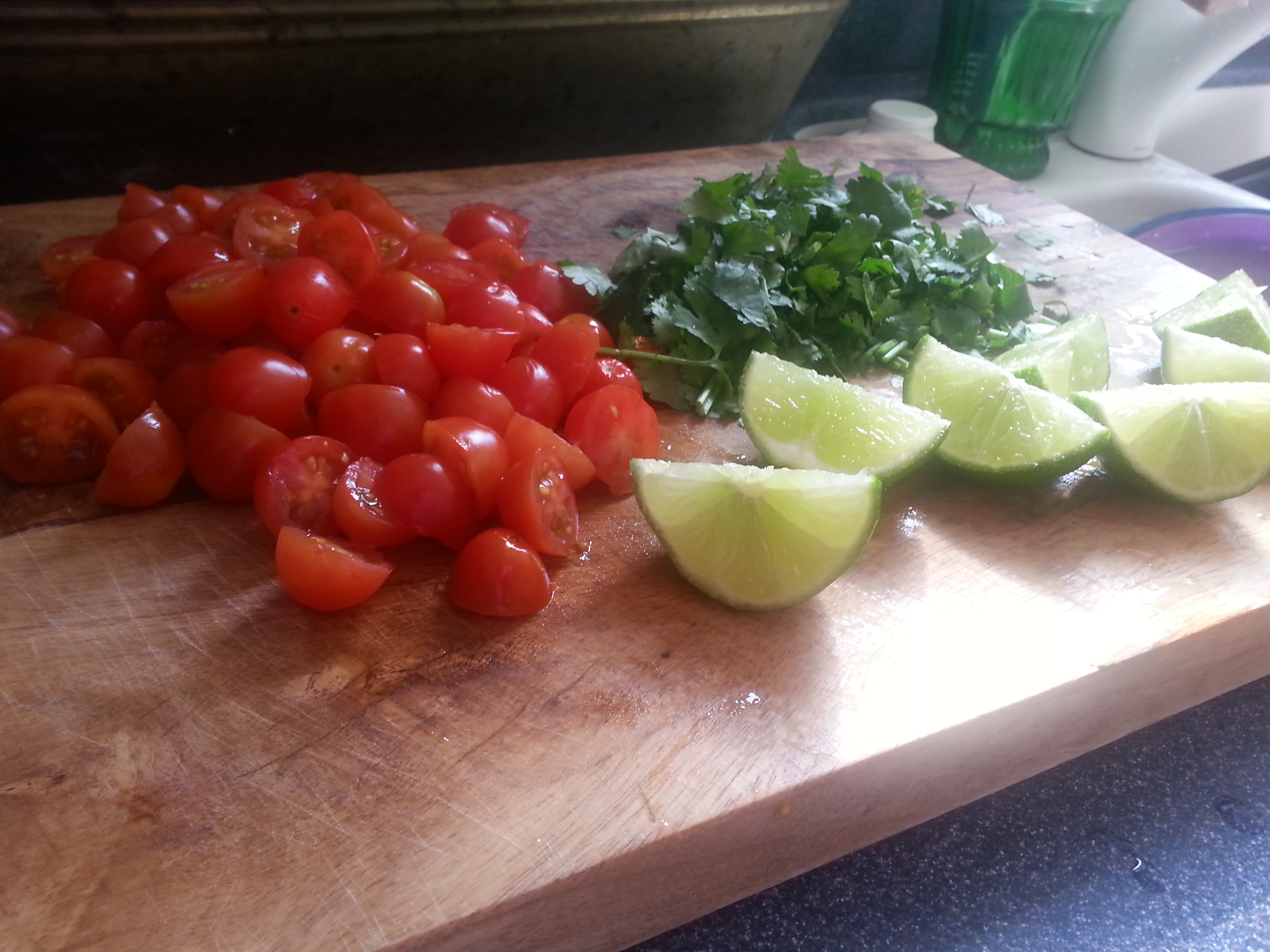
A few other high points: whipping olive oil, and egg, and some lemon juice into mayonnaise that’s better than anything you can buy, better skin from our increased avocado consumption, and making Paleo spaghetti with our friend Adam, who came to visit us right in the middle of our Whole30 and jumped right in with us. Roasted brussels sprouts and bacon. Coffee with a sprinkle of cinnamon and plain almond milk. Sparkling water (Silas calls it spicy water) with a squeeze of fresh lime. Berries with a dollop of whipped coconut cream, no sugar necessary. A new appreciation for the beauty and versatility of whole foods.

A low point: discovering I’m allergic to plaintains. What the what.

It may seem like unnecessary self-torture, but I’ve also been reading Shauna Niequist’s luscious book Bread and Wine: A Love Letter to Life Around the Table during our Whole30. It was just too beautiful of a book to put down until February 25th (oh yes, I’m counting down at this point.) The book is full of mouth-watering recipes like blueberry crisp, breakfast cookies, and risotto, but there’s also a chapter called Feasting and Fasting that strengthened my resolve. She writes:

I love the feasting part of life. I don’t want Thanksgiving without stuffing or Christmas without cookies and champagne. I don’t want to give up our family tradition of deep-frying everything we can think of on New Year’s Eve. But I’m learning that feasting can only exist healthfully–physically, spiritually, and emotionally–in a life that also includes fasting.

And:

Fasting gives me a chance to practice the discipline of not having what I want at every moment, of limiting my consumption, making space in my body and in my spirit for a new year, one that’s not driven by my mouth, by wanting, by consuming. (both quotes from Kindle edition, p. 133)

On days when I’m home with my children, my life seems to revolve around food. Ricky and I alternate making breakfast, then there’s a morning snack, then lunch, then dinner planning mid-afternoon if I’m on top of things, then making said dinner while handing hungry children slices of clementine oranges to tide them over, then a steaming cup of reward-tea after all littles are tucked into bed. I don’t go more than two hours without thinking about food, and sometimes it feels like a burden. It makes me think of some nursing shifts, when I would run like mad from 7 AM until 2 or 3 in the afternoon, and suddenly realize I hadn’t eaten anything, find some food to inhale, and get back to running. There was something freeing about it, in a way–being too busy to think about food very much.

Fasting is different, though. Fasting is when you’re thinking of food but intentionally moving those thoughts elsewhere. That’s more like what this Whole30 has felt like–spanning lots of cooped-up, snowy days and the holiday of chocolate and sugar. I feel a new sturdiness inside. I have more energy. I really, really want to eat the things I can’t have, simply because I’ve told myself I can’t have them.

There’s a space in my life that isn’t being immediately filled. That, I think, is the point of all this.

I’m fascinated by the parallels between my relationship to food and my spiritual well-being. Our church foremothers and fathers were onto something big as they observed the church calendar, which is essentially a series of feasts and fasts.  I’m in Church Calendar Kindergarten right now, but I’m loving the guidelines I find there.  They help as we try to settle into a rhythm of enjoying the bounty of the earth and caring for our bodies,  holding ourselves back from having all things at all times, making the days of fasting worth it, and the days of feasting a true reward.

Those are kind of lofty words for a cheater-pants, I know. Fasting is about humility, too. Let’s just hope we can make it five more days.

Leave a comment

Filed under Uncategorized